Geothermal Potential
Using QuickOSM, and QGIS plugins, the land use layer is downloaded. Within the land-use layer, all land areas unsuitable for the construction of solar collector systems were removed from the attribute table. Suitable land areas are those that are not parks, transportation infrastructure, protected areas and do not have existing buildings. After that, the land-use layer was overlaid with the Natura 2000 layer to eliminate all protected areas. With this, we identified suitable areas for solar thermal.
For the identified suitable land areas, the surface area of each parcel was calculated using the Field Calculator and the "$area" command in the attribute table of the final layer. This step allows quantification of the available surface area for the installation of a vertical double-loop ground heat exchanger to utilize shallow geothermal energy.
To evaluate the technical feasibility and cost implications of deploying a vertical ground heat exchanger system for district heating, the following methodology was adopted. The calculation is based on available land area and typical engineering design parameters for vertical double U-tube borehole heat exchangers.
Land Area and Borehole Spacing
Let:


The maximum number of boreholes  that can be installed within the available land area is estimated by dividing the total area by the area required per borehole, assuming a uniform square grid:
|
|
(1) |

This formulation assumes minimal spacing required to prevent thermal interference between adjacent boreholes, typically in the range of 5–6 m for district-scale systems. 0.95 is assumed land coverage for GHE since GHE needs area for auxiliary equipment.
Total Borehole Length
Let:
|
|
(2) |

Then, the total installed borehole length  is given by:
|
|
(3) |

Total Heat Extraction Capacity
Let:
|
|
(4) |

The total heat extraction capacity  of the GHE field is then estimated as:
|
|
(5) |

This capacity represents the steady-state heat that can be sustainably extracted from the ground under long-term operating conditions.
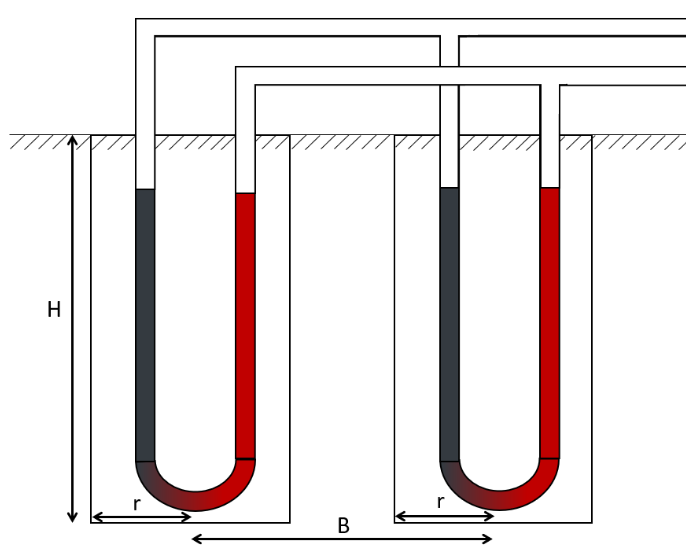
Figure 1 Vertical borehole double loop heat exchanger.
Table 1 Parameters overview
|
Parameter |
Typical Value |
Reference |
|
Heat conductivity |
>1.2 W/(mK) |
[1] |
|
Heat extraction rate per meter, q_b |
60 W/m |
[2], [3] |
|
Typical borehole depth, h_b |
100 m |
[4], [5] |
|
Borehole spacing, b |
6 m |
[6] |
- Disclaimer
This methodology enables quick first-order estimation of the scale and cost of a GHE field for integration into district heating networks. For precise system sizing, transient thermal response modelling and site-specific geological surveys are recommended.
- References
[1] “ThermoMap MapViewer.” Accessed: Jun. 04, 2025. [Online]. Available: https://www.thermomap.eu/index.html?lang=en
[2] K. Salhein, C. J. Kobus, M. Zohdy, A. M. Annekaa, E. Y. Alhawsawi, and S. A. Salheen, “Heat Transfer Performance Factors in a Vertical Ground Heat Exchanger for a Geothermal Heat Pump System,” Energies 2024, Vol. 17, Page 5003, vol. 17, no. 19, p. 5003, Oct. 2024, doi: 10.3390/EN17195003.
[3] “Sizing of geothermal borehole fields: Calculation and validation - nPro.” Accessed: Jun. 04, 2025. [Online]. Available: https://www.npro.energy/main/en/help/geothermal-borehole-calculation?utm_source=chatgpt.com
[4] Collection of Authors, “Scenario Catalogue Integration of Geothermal Energy into District Heating and Cooling Networks,” Nov. 2023. [Online]. Available: www.saphea.eu
[5] E. Nilsson and P. Rohdin, “Performance evaluation of an industrial borehole thermal energy storage (BTES) project – Experiences from the first seven years of operation,” Renew Energy, vol. 143, pp. 1022–1034, Dec. 2019, doi: 10.1016/J.RENENE.2019.05.020.
[6] “How much space is needed for a ground source heat pump? - IMS Heat Pumps,” https://www.imsheatpumps.co.uk/, Accessed: Jun. 04, 2025. [Online]. Available: https://www.imsheatpumps.co.uk/blog/how-much-space-is-needed-for-a-ground-source-heat-pump/